
Why this small valley keeps you moving
Kashmir is roughly 140 kilometres end to end, and I have driven most of it in a single long day scouting the best places to visit in Kashmir. What still surprises me, five trips in, is how completely the landscape re-invents itself inside that distance. You can be paddling through mist on Dal Lake at sunrise, standing in wind-scoured snow above Gulmarg by lunch, and walking a pine-scented riverbank in Pahalgam before dark — three different countries, on paper one valley.
The Trail · Top 10 Places to Visit
- One card per stop · photo side, message side
- Best for · Heritage
- No. 01
- Srinagar
- Dal Lake & the Old City
-
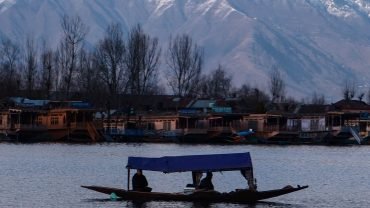
I have never found a quieter version of any city than Dal Lake at 5:40 in the morning. The water sits flat as pressed tin, mist hangs a foot above it, and the only sound for a long stretch is a paddle turning over. By seven the floating vegetable market has assembled itself out of nowhere — men standing in shikaras trading bundles of lotus stem and haakh across the gunwales.
Then there is the Old City on the other side of the Jhelum, which most visitors skip and shouldn't. Downtown Srinagar is carved walnut balconies, brick-and-timber houses leaning into each other, coppersmiths hammering samovars, and the smell of bakery bread pulled hot off the tandoor wall at Naid Kadal.
- Signature experience: a pre-dawn shikara ride to the floating market, followed by breakfast of girda bread and salt tea on the boat.
- Tips
- Book the shikara the night before directly with the boatman at your ghat, not through the hotel desk — you’ll pay about half and leave a full hour earlier, which is the whole point.
- No. 02
- Gulmarg
- The meadow of flowers, 2,650 m
- Gulmarg is where Kashmir stops being pretty and starts being big. The wind coming off Apharwat cuts straight through a rented jacket, and from the second stage of the gondola at nearly 4,000 metres the valley drops away in white folds until it runs into Nanga Parbat on a clear day. I stood there in February with my eyes watering and did not care.
- It is not only a winter place. In July the bowl becomes an enormous green saucer of wildflowers, ringed by pine, with the world's highest golf course laid over the middle of it and horses grazing on the fairway edges.
- Signature experience: Phase 2 of the Gulmarg Gondola to Apharwat Peak, then walking out along the ridge until the crowds thin.
- Tips
- Buy gondola tickets online the moment your dates are fixed; Phase 2 sells out days ahead in peak season, and the counter queue can eat your entire morning.
- Best for · Adventure
- Best for · Nature
- No. 03
- Pahalgam
- Lidder Valley, Anantnag
- Pahalgam smells like crushed pine needles and cold water. The Lidder comes down glacier-grey and loud, and you can hear it from inside your room with the windows shut — which is the reason to stay a night rather than day-trip in. I walked the riverbank path towards Ganeshbal one evening and passed shepherd families moving flocks down to lower pasture, the whole procession moving at the pace of the slowest lamb
- Of the ten places here, this is the one that best suits travellers of every age at once: short flat walks, easy pony rides, meadows to sit in, and enough shade for a long lunch.
- Signature experience: the walk upriver from Pahalgam market to Baisaran meadow — pine forest, then a sudden open lawn with the valley below.
- Tips
- Agree pony rates and the exact turnaround point before mounting, and pay at the end. The fixed government rate board sits near the taxi stand — photograph it.
- No. 04
- Sonamarg
- Meadow of gold, Ganderbal
- The drive to Sonamarg is half the destination — the road follows the Sindh river through Kangan and Gagangir, with the water switching from jade to slate depending on the light. Then the gorge opens and you're on a wide floor of gold-tinged grass with glaciers hanging above it on three sides
- Thajiwas Glacier is the standard outing: a couple of kilometres up on foot or by pony to a snout of grubby, ancient ice where locals sell tea from kettles balanced on stones. Sonamarg is also the last real stop before the Zojila pass into Ladakh, and it feels like a threshold.
- Signature experience: walking up to Thajiwas Glacier early, before the pony trains churn the trail into mud.
- Tips
- Sonamarg is a day trip from Srinagar only if you leave by 6 a.m.; the Zojila-bound truck convoy fills the single-lane sections by mid-morning and you'll lose two hours to it.
- Best for · Adventure
- Best for · Nature
- No. 05
- Betaab Valley
- 7 km from Pahalgam
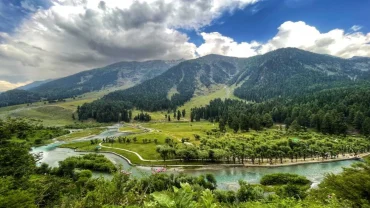
- Betaab Valley looks so much like a film set that it is, in fact, named after one. The valley floor is an almost unnaturally flat lawn of grass split by a stream, walled in on both sides by steep pine slopes that climb into snow. The scale plays tricks: people standing at the far fence look like pins.
- Betaab Valley looks so much like a film set that it is, in fact, named after one. The valley floor is an almost unnaturally flat lawn of grass split by a stream, walled in on both sides by steep pine slopes that climb into snow. The scale plays tricks: people standing at the far fence look like pins.
- Signature experience: crossing the little footbridge over the stream and following the far bank to the tree line, where the manicured part ends.
- Tips
- Pair it with Chandanwari and Aru in one shared-taxi circuit from Pahalgam, and do Betaab last — late afternoon light hits the pine walls instead of flattening them
- No. 06
- Shalimar Bagh
- Mughal garden, Srinagar
- Shalimar Bagh was Jahangir's gift to Nur Jahan in 1619, and four centuries later it still does exactly what it was engineered to do: pull your eye up four terraces along a single stone water channel, past rows of fountains, into the mountains behind. The genius is the gradient — every drop of movement in the water is gravity, not machinery.
- The top terrace, the old zenana garden with its black marble pavilion, is where I'd spend the time. Under the chinars the temperature falls a couple of degrees and the crowd noise from the entrance simply stops.
- Signature experience: standing at the black marble pavilion on the uppermost terrace and looking straight down the central axis to the lake.
- Tips
- Go at opening time or in the last hour before sunset. Midday flattens the terraces and fills every frame with visitors; the fountains also run more reliably in the evening slot.
- BEST FOR · HERITAGE
- BEST FOR · HERITAGE
- No. 07
- Nishat Bagh
- Shalimar BaghGarden of joy, Dal Lake shore
- If Shalimar is the more royal garden, Nishat has the better view. Twelve terraces step down the Zabarwan foothills towards Dal Lake, and from the upper levels you get the full sweep of water with Hari Parbat and the Pir Panjal beyond. Chinars here are enormous, some of them older than most buildings in the cit
- In April the tulip garden next door draws the crowds, but Nishat's own flowerbeds hold up all season — irises early, roses and cosmos later. It is the garden where I've spent longest simply sitting on a low wall doing nothing.
- Signature experience: walking down from the top terrace at golden hour as the lake turns copper below the fountains.
- Tips
- Arrive by shikara from the Nehru Park side instead of by road — you land at the lakefront steps, skip the parking scrum, and see the garden the way it was designed to be approached.
- No. 08
- Hazratbal Shrine
- Northern shore, Dal Lake
- Hazratbal is the most revered shrine in Kashmir, the only mosque in Srinagar with a classic dome and minaret, and it sits right at the water's edge on Dal Lake's northern shore. White marble against lake and mountain at dusk is a genuinely arresting sight, and the courtyard fills with pigeons that lift in one sheet when children run at them.
- It is first and foremost a living place of worship, so the visit is about atmosphere rather than sightseeing: the call to prayer rolling out over the water, families spread on the marble, vendors selling roasted corn along the approach.
- Signature experience: sunset in the lakeside courtyard as the marble goes from white to rose and the evening prayer begins.
- Tips
- Dress modestly, women should carry a scarf, and avoid Friday afternoons unless you intend to be part of the congregation rather than a visitor moving through it
- BEST FOR · HERITAGE
- BEST FOR · OFFBEAT
- No. 09
- Aru Valley
- 12 km beyond Pahalgam
- Aru is where the Lidder valley loosens its collar. A hamlet of wood-and-tin houses, a scatter of grazing sheep, meadows that run up to bare ridgelines, and the trailhead for the Kolahoi glacier and the Tarsar-Marsar lakes. Trekkers treat it as a starting point; I'd argue it's a destination for anyone willing to trade facilities for quiet.
- Stay overnight and the difference is dramatic. Day visitors clear out by five, the valley goes cold and enormous, and the sky over Aru is the best I've seen anywhere in Kashmir.
- Signature experience: the gentle two-hour walk up towards Lidderwat, turning back at the first shepherd settlement.
- Tips
- Mobile data is unreliable and there are no ATMs — carry cash and download offline maps in Pahalgam. Guesthouses here are simple; ask for a room with a bukhari stove.
- No. 10
- Doodhpathri
- Valley of milk, Budgam
- Doodhpathri is what people mean when they say they wish they'd seen Kashmir before the crowds. Rolling meadow, no built-up bazaar, and a shallow stream running white over pale stone — hence the name, valley of milk. I sat in the grass for an hour with nothing to look at but hillside and the water, and it remains my clearest memory of the trip.
- There's very little infrastructure: a few tea stalls, some horse handlers, no hotels worth planning around. That is precisely its value on a ten-day itinerary that otherwise runs through well-worn stops.
- Signature experience: walking upstream from the parking area until the tea stalls are out of sight, then simply sitting down.
- Tips
- It's a two-hour drive from Srinagar and best done as a day trip with a packed lunch — there is no reliable food, and the last stretch of road is rough enough that you want to be heading back well before dark.
- BEST FOR · OFFBEAT
Sort Your Trip
Ten destinations, one valley, and never enough days. Rather than ranking them, sort them the way you’d sort postcards in a rack — by the trip you actually want. Pick the column that sounds like you, and let it decide where you sleep.
→ Srinagar
Heritage & gardens
Base entirely in Srinagar. Two full days covers the Old City’s woodwork and coppersmiths, Shalimar and Nishat at opposite ends of the day, Hazratbal at dusk, and a slow morning on Dal Lake. You’ll barely sit in a car.
→ Gulmarg + Sonamarg
Adventure & snow
Give Gulmarg two nights so a whiteout day doesn’t cost you Apharwat, and add Sonamarg for the Thajiwas walk. January to March for skiing and deep snow; June for high-altitude trails without ice.
→ Pahalgam
Family-friendly nature
Pahalgam is the softest landing: flat riverside paths, pony rides, Betaab Valley twenty minutes away, and rooms within earshot of the Lidder. Three nights here beats three one-night hops across the valley.
→Doodhpathri + Aru
Offbeat & quiet
Take Doodhpathri as a day trip from Srinagar and stay a night in Aru. Thin infrastructure, cash only, unreliable data — and in exchange, meadows where you may see nobody for an hour.
Mixing works too, and it’s what I’d do with a week: two nights in Srinagar for heritage, two in Pahalgam for the river, one in Gulmarg for altitude, and a single offbeat day out to Doodhpathri on the way to the airport.
Best Time to Visit These Places
Kashmir doesn’t have one best season — it has a different one per cluster. A quick stamp for each, with the full month-by-month breakdown in the seasonal guide
Srinagar, Shalimar, Nishat, Hazratbal
Gardens at full strength, tulips in April, chinars in leaf. October gives you the same terraces in rust and gold with a fraction of the crowds.
Jun – Aug
Gulmarg
Deep snow and skiing in winter; wildflower meadow and golf in summer. Avoid late March, when it is neither.
Pahalgam, Betaab, Aru
Roads reliably open, the Lidder running hard with meltwater, meadows green. Trekking to Tarsar-Marsar peaks in July and August.
September
Sonamarg, Doodhpathri
Both are seasonal. Sonamarg’s road opens once Zojila clears; Doodhpathri’s last stretch is unpleasant in heavy rain or snow.
The trips I remember from Kashmir are the ones with the fewest entries on the itinerary. Two or three of these destinations, given real time, will hand you the hush of Dal Lake before the city wakes, an afternoon that ends only because the light goes, and a meadow you sat in long enough to hear the stream properly. Ten destinations in six days hands you a photo library and a sore back.
So use this trail as a menu, not a checklist: one lake-and-heritage base, one high or green valley, and if you can spare a day, one genuinely quiet corner. Kashmir is small enough that you can always come back for the rest — and specific enough that you will want to.
Things travellers actually ask
The essential list runs Srinagar (Dal Lake, Old City), Gulmarg, Pahalgam, Sonamarg, Betaab Valley, Shalimar Bagh, Nishat Bagh, Hazratbal Shrine, Aru Valley, and Doodhpathri. Most travellers pick two or three clusters rather than trying to cover all ten in one trip.
Six to seven days is enough to cover one heritage base (Srinagar), one high-altitude valley (Gulmarg or Sonamarg), and one green valley (Pahalgam), without spending most of your trip in a car. Ten days lets you add an offbeat day out to Doodhpathri or Aru.
It depends on which places you’re prioritising. Srinagar’s gardens peak April–June (tulips in April) and again in October for autumn colours. Gulmarg splits into a winter ski season (January–March) and a summer meadow season (June–August). Pahalgam and Betaab are best May–September, while Sonamarg and Doodhpathri only open from late May once the roads clear.
Yes — it’s effectively two different destinations. Winter (Jan–Mar) means snow, skiing, and the gondola ride to Apharwat Peak. Summer (Jun–Aug) turns the same slopes into a wildflower meadow with golf and horse grazing. Late March tends to fall awkwardly between the two seasons.
Yes, this is the most common circuit. A week built around two nights in Srinagar, two in Pahalgam, and one or two in Gulmarg covers heritage, river valleys, and altitude without excessive road time between stops.


Comment (0)